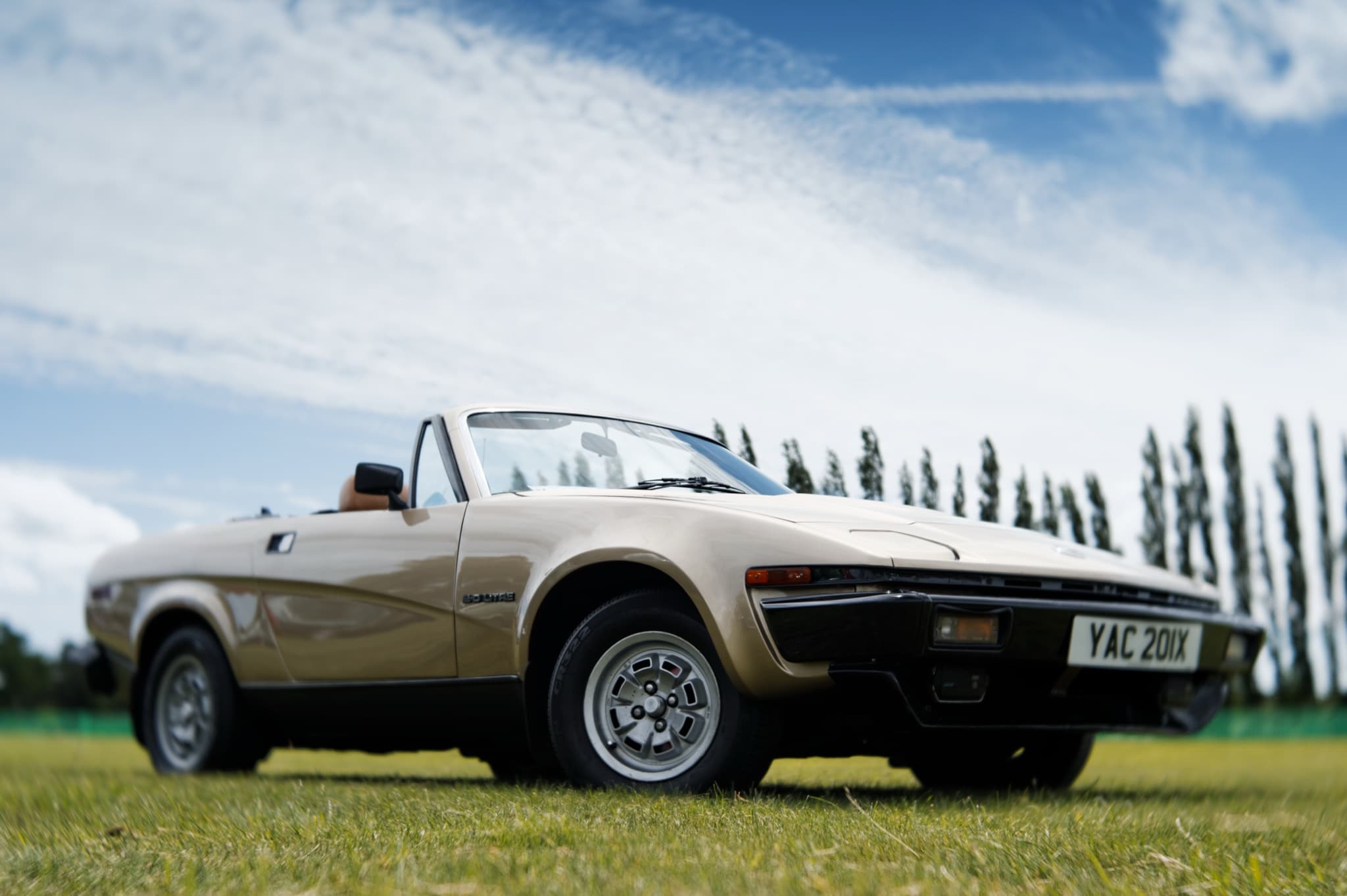
Triumph TR7 Convertible
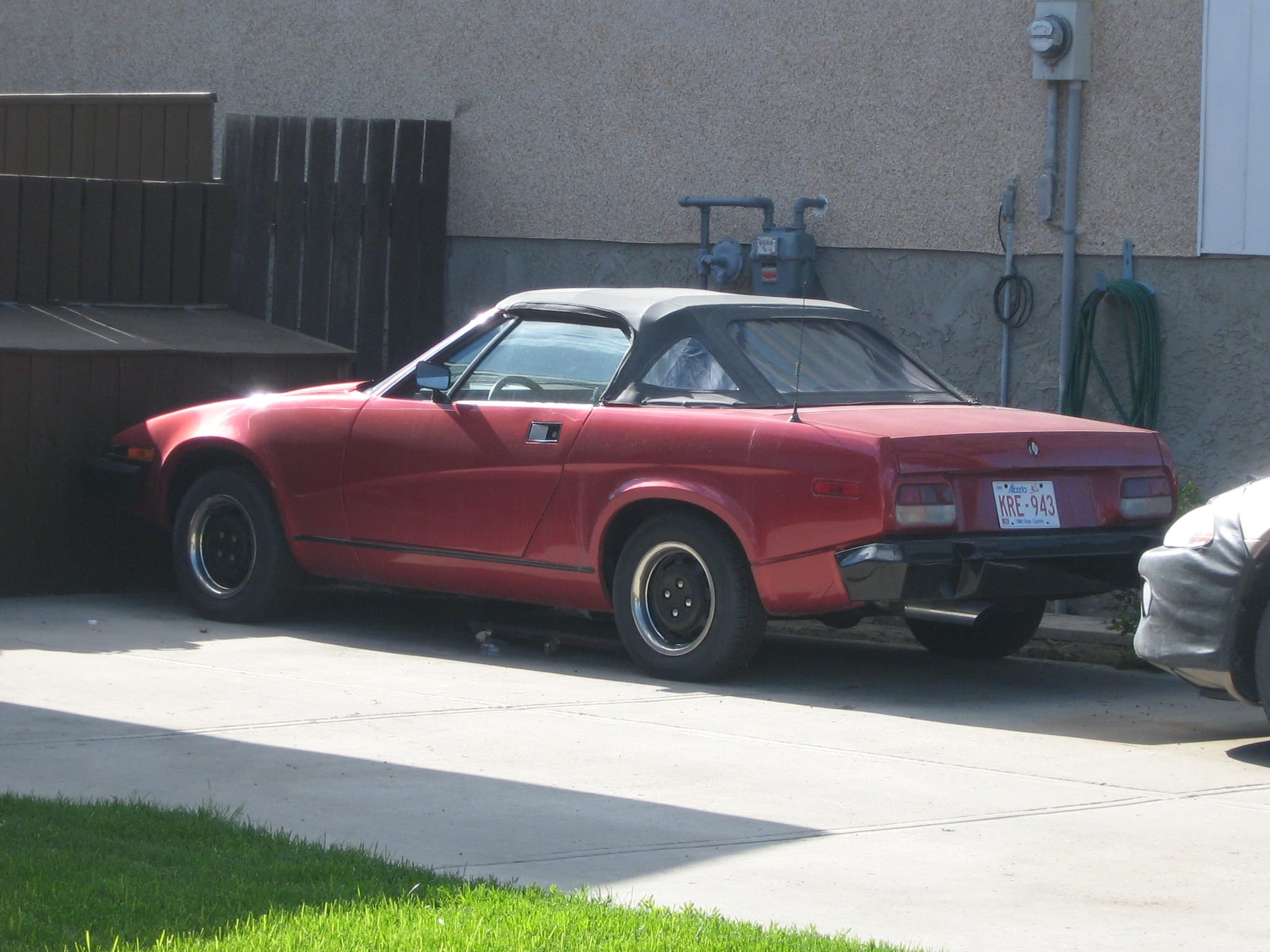
The open TR7, sold as the Triumph TR7 Convertible in North America from 1979 and as the TR7 Drophead in Britain from 1980: British Leyland's drophead coupé (DHC), made from a Michelotti prototype and built at Canley and Solihull until October 1981.
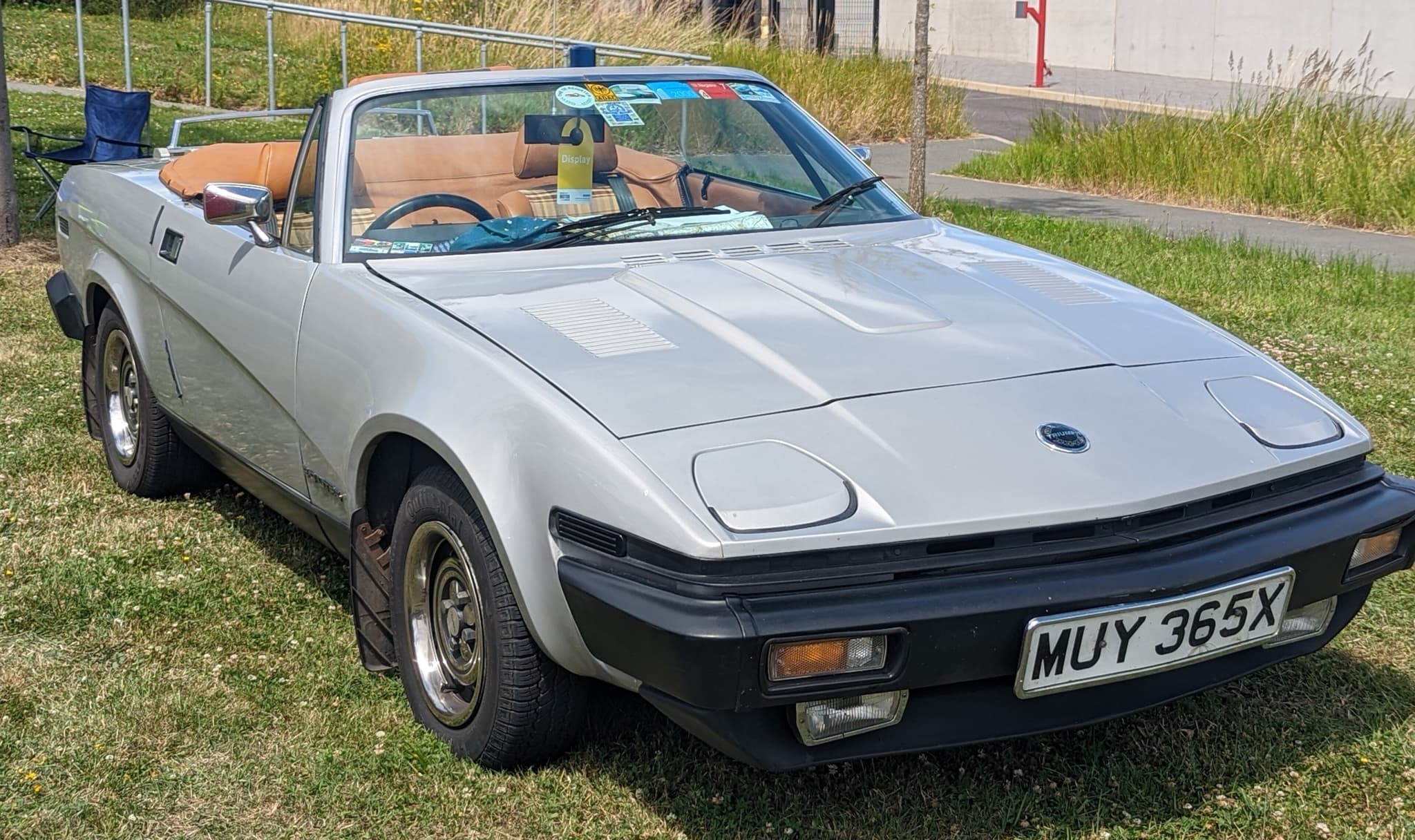
A late British TR7 convertible, registered in 1981–82, its hood (soft top) folded, photographed from low on the grass at the Luton Festival of Transport in 2017.pyntofmyld, CC BY 2.0
The convertible was the TR7 that American safety rules had seemed to forbid when the car was designed. Its American launch came in the summer of 1979, four years after the coupé's, and Britain had it in March 1980, the year before the TR7 ended. The last TR7 of all, built in October 1981, was a right-hand-drive drophead, now the last TR7 at Gaydon.source 1source 2source 3source 4source 5
Development and engineering
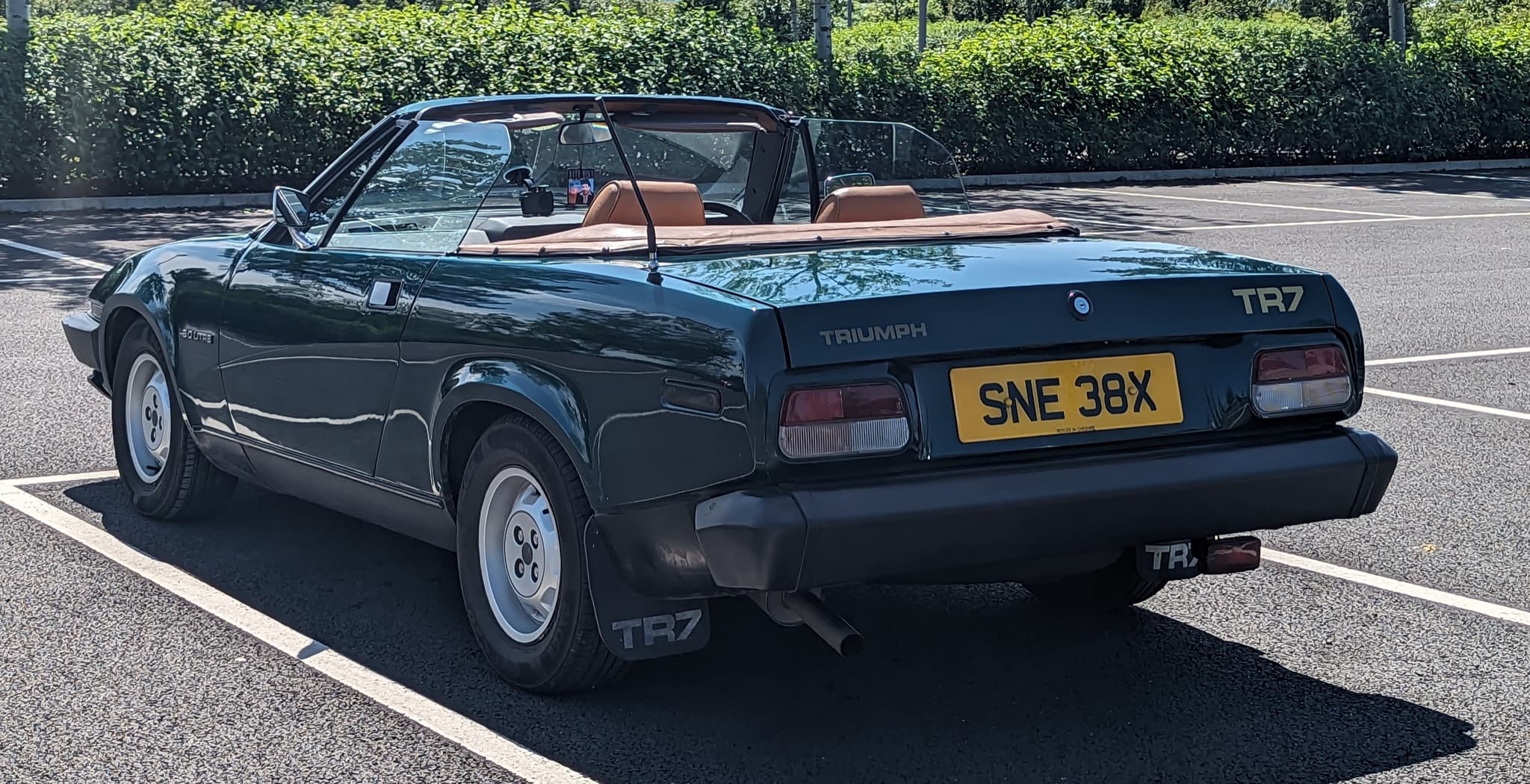
The TR7 had been a coupé because open cars were expected to be outlawed in America. They were not. The proposed American standard on roof crush failed a court challenge in 1972, Ate Up With Motor writes, and was revised to exempt convertibles; by the time the court had ruled, Motor Sport explained in 1980, it was too late to engineer an open version for the TR7's launch. Work on one began in 1976, AROnline writes, and Road & Track reported in 1979 that money and labour troubles had held its introduction back by about a year.
The prototype came from Michelotti, Ate Up With Motor writes; Triumph did the engineering. With the roof gone, the body needed strength put back. Rover Triumph's own account, issued for the British launch in March 1980, lists an extra box section behind the seats, tied into the pillars behind the doors; rear quarter panels carried down into the sills; and tongue-and-groove fixings above the door latches. Road & Track added stronger suspension mountings and front crossmember, a panel under the rear deck and a stiffer windscreen (windshield) frame. For the shake that open cars suffer, the engineers turned to the front bumper:
By making use of the substantial front bumper armature, which is pivotted at its centre and fitted with carefully tuned weights at its ends, Triumph development engineers have provided an effective and weight-saving antidote to scuttle shake.
A test car, the release adds, covered about 1,600 km (1,000 miles) of the pavé at MIRA, which it calls the equivalent of "at least 100,000 normal road miles", without fatigue. Outside, the convertible has a new rear deck, lower and flat, without the coupé's raised tail. And it weighed no more: BL's figures for 1980 make each convertible slightly lighter than the coupé with the same gearbox (transmission), and Motor Sport, working from the release's figures, called it "5 kg. lighter than the fixed-head". The specifications give the figures.
Speke built about 10 pre-production convertibles in April and May 1978, the TR Drivers Club records, and they were later converted to V8s at Canley.
The hood
The hood (soft top) folds behind the seats under a cover, without taking room from the boot (trunk). Raised, it reminded people of another car: Road & Track wrote that "nearly everyone who sees it comments on how much it looks like the Mercedes-Benz 450SL convertible top". Motor Sport, testing the British car in 1980, found the driving best with it put away: "But really the best way to enjoy this Triumph is at more modest speeds with the hood down."source 3source 5source 2
Launches and markets
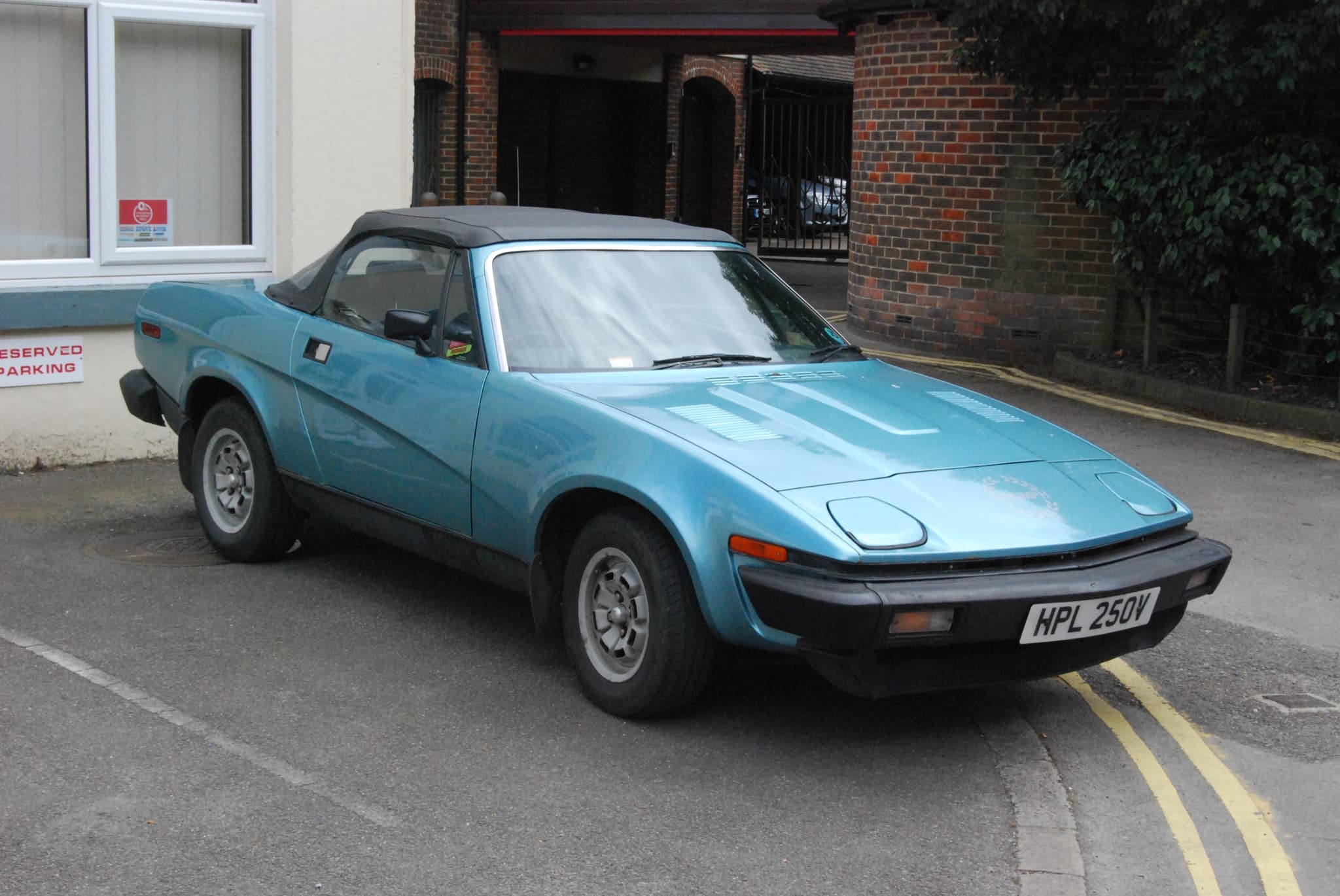
The first convertibles were built at Canley from January 1979, for the American 1979 model year, with commission numbers beginning TCT. One was shown at the Los Angeles Auto Expo that spring, and the car was on sale in the United States "by July 1", Road & Track reported; AROnline's timeline also gives July 1979, though its text says May. In Canada the brochure called it "the first new production convertible in a decade".
Britain waited until March 1980. Rover Triumph's release was embargoed until Sunday 2 March, the press drove the cars at Woburn Abbey, and the drophead was shown at Geneva the same month. Motor Sport passed on BL's claim, with a correction:
… the first mass-produced sports convertible to be introduced in the UK since the Triumph TR6 was revealed eleven years ago (not twelve, as the BL Press Release has it) …
It cost "some £794 more" than an MGB, the magazine noted, and £217 less than the coupé, with alloy wheels £260 extra; its five-speed gearbox was standard. From April 1980 convertibles were built at Solihull too, and once Canley closed that August, there alone. Ate Up With Motor reports that BL expected more than three-quarters of the later TR7s to be convertibles.source 4source 8source 2source 6source 1source 3source 9source 5source 10
American convertibles
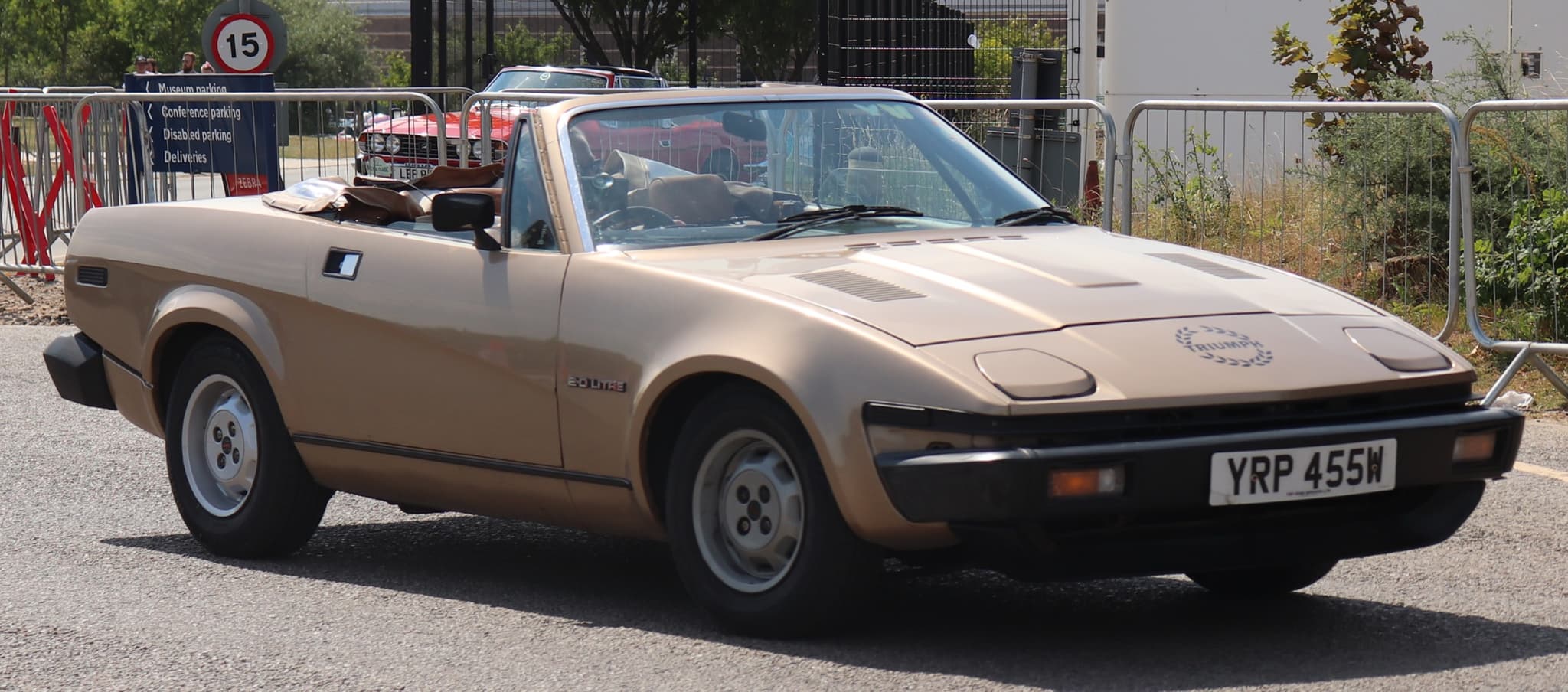
The American convertibles had the federal engine: twin Zenith-Stromberg carburettors outside California, and from 1 July 1980 Bosch fuel injection on California's cars, the first of them number 401225, by Michael Hart's count of the factory build cards. For the 1981 model year every American TR7 was injected. The Spider was an American edition of the convertible for the 1980 model year, built at Solihull; special editions gives Hart's count. The North American TR7s page follows the cars by model year, and the TR8, the V8 convertible sold beside them in 1980 and 1981, will have its own site, triumph-tr8.com.source 5source 11source 2
Verdicts
The testers liked the open car better. Road & Track saw it first:
It simply looks right-it's what the car should have been all along, with a clean, crisp shape that evokes notions of speed and sports car driving excitement.
Motor Sport found the handling unchanged by the open body, and less of the body boom above 4,000 rpm than in the closed one. More of what the testers said is on the road tests.
No source read gives a reliable total for the convertible. BL's calendar-year table has no row for convertibles in 1979, though American convertibles were built from January that year, so its rows count only 1980 and 1981, which the production figures below give. The larger total that Wikipedia gives, from the German Oldtimer Katalog, is one BL's published tables cannot confirm.source 2source 3source 12source 4
Specification: Convertible
Production
Sources for Production, Convertible
- Price new
- One good source.UK, 1980; £794 more than the MGB. "C.R.", "The Triumph TR7 Drophead" ("Sunshine Seven"), Motor Sport, Apr 1980, p. 35source 3
- Built
- Several figures in print.Paul Towle and Rex Holford (update) and Mark Elbers (update), "TR7 & TR8 Identification & Production Data Explained", TR Drivers Club, 1987, updated (© 2016)source 4; Thos L. Bryant, "New from Britain: Triumph TR7 Convertible & TR8", Road & Track (reprinted by the TR Drivers Club), 1979source 2
- Built at
- One good source.Drophead production. Paul Towle and Rex Holford (update) and Mark Elbers (update), "TR7 & TR8 Identification & Production Data Explained", TR Drivers Club, 1987, updated (© 2016)source 4
| Price new | £5,958 |
|---|---|
| Built | from January 1979 (TCT 100001, 1979 model year) Built, Convertible Several figures in print.
|
| Built at | Canley (TCT, from January 1979); Solihull (from April 1980) |
Engine
Sources for Engine, Convertible
- Engine maker
- One good source.The TR7's engine. Aaron Severson, "Way of the Wedge: The Triumph TR7 and TR8", Ate Up With Motor, 5 Feb 2012, pp. 1–5source 5
- Capacity
- Good sources agree."1998 cc. (122 cu. in.)". Jaguar Rover Triumph Canada (Burlington, Ontario), Triumph TR7 Convertible (sales brochure), Canada, c. 1979–80source 10; Rover Triumph (reprinted by the TR Drivers Club), "Triumph TR7 Drophead: Structural Engineering and Specifications" (press release), Press release, for release 2 Mar 1980source 1
- Engine position
- One good source.The TR7, 1975. Clive Richardson ("C.R."), "The TR7 makes a quiet British bow", Motor Sport, Feb 1975, p. 30source 13
- Block
- One good source.Triumph's slant four (and V8) as designed. Aaron Severson, "Way of the Wedge: The Triumph TR7 and TR8", Ate Up With Motor, 5 Feb 2012, pp. 1–5source 5
- Cylinder head
- One good source.Early TR7s: head-gasket failure "with an attendant risk of warping the aluminum head". Aaron Severson, "Way of the Wedge: The Triumph TR7 and TR8", Ate Up With Motor, 5 Feb 2012, pp. 1–5source 5
- Valve gear
- One good source.The TR7 engine, 1979 ("in other major respects the TR7 is unchanged"). Clive Richardson ("C.R."), "The Triumph TR7", Motor Sport, Jun 1979, p. 58source 8
- Bore × stroke
- Several figures in print.Rover Triumph (reprinted by the TR Drivers Club), "Triumph TR7 Drophead: Structural Engineering and Specifications" (press release), Press release, for release 2 Mar 1980source 1; Jaguar Rover Triumph Canada (Burlington, Ontario), Triumph TR7 Convertible (sales brochure), Canada, c. 1979–80source 10
- Compression ratio
- Several figures in print.Rover Triumph (reprinted by the TR Drivers Club), "Triumph TR7 Drophead: Structural Engineering and Specifications" (press release), Press release, for release 2 Mar 1980source 1; Jaguar Rover Triumph Canada (Burlington, Ontario), Triumph TR7 Convertible (sales brochure), Canada, c. 1979–80source 10
- Fuel system
- One good source.Rover Triumph (reprinted by the TR Drivers Club), "Triumph TR7 Drophead: Structural Engineering and Specifications" (press release), Press release, for release 2 Mar 1980source 1
- Carburettors
- One good source.UK. Rover Triumph (reprinted by the TR Drivers Club), "Triumph TR7 Drophead: Structural Engineering and Specifications" (press release), Press release, for release 2 Mar 1980source 1
- Cooling
- One good source.The TR7's engine. Simon Godrich, "TR7 Tribulations" (owner's checklist), TR Drivers Clubsource 14
- Cylinder layout
- Several figures in print.Rover Triumph (reprinted by the TR Drivers Club), "Triumph TR7 Drophead: Structural Engineering and Specifications" (press release), Press release, for release 2 Mar 1980source 1; Jaguar Rover Triumph Canada (Burlington, Ontario), Triumph TR7 Convertible (sales brochure), Canada, c. 1979–80source 10
- Aspiration
- One good source.Rover Triumph (reprinted by the TR Drivers Club), "Triumph TR7 Drophead: Structural Engineering and Specifications" (press release), Press release, for release 2 Mar 1980source 1
- Fuel
- One good source.Rover Triumph (reprinted by the TR Drivers Club), "Triumph TR7 Drophead: Structural Engineering and Specifications" (press release), Press release, for release 2 Mar 1980source 1
- Cycle
- One good source.Rover Triumph (reprinted by the TR Drivers Club), "Triumph TR7 Drophead: Structural Engineering and Specifications" (press release), Press release, for release 2 Mar 1980source 1
| Engine maker | Triumph |
|---|---|
| Capacity | 1998 cc |
| Engine position | Front |
| Block | iron |
| Cylinder head | Aluminium |
| Valve gear | single-overhead camshaft, eight valve cylinder head |
| Bore × stroke | 90.3 × 78.0 mm Bore × stroke, Convertible Several figures in print.
|
| Compression ratio | 9.25:1 Compression ratio, Convertible Several figures in print.
|
| Fuel system | Carburettors 2XSU-HS6 side draught tamper proofed |
| Carburettors | two SU HS6 |
| Cooling | Water-cooled |
| Cylinder layout | in line, inclined 45° Cylinder layout, Convertible Several figures in print.
|
| Aspiration | Naturally Aspirated |
| Fuel | Petrol |
| Cycle | Four-stroke |
Performance
Sources for Performance, Convertible
- Power
- Several figures in print.Rover Triumph (reprinted by the TR Drivers Club), "Triumph TR7 Drophead: Structural Engineering and Specifications" (press release), Press release, for release 2 Mar 1980source 1; Aaron Severson, "Way of the Wedge: The Triumph TR7 and TR8", Ate Up With Motor, 5 Feb 2012, pp. 1–5source 5; Jaguar Rover Triumph Canada (Burlington, Ontario), Triumph TR7 Convertible (sales brochure), Canada, c. 1979–80source 10
- Torque
- One good source.161 Nm at 3,500 rpm; UK. Rover Triumph (reprinted by the TR Drivers Club), "Triumph TR7 Drophead: Structural Engineering and Specifications" (press release), Press release, for release 2 Mar 1980source 1; Jaguar Rover Triumph Canada (Burlington, Ontario), Triumph TR7 Convertible (sales brochure), Canada, c. 1979–80source 10
| Power | 105 bhp Power, Convertible Several figures in print.
|
|---|---|
| Torque | 119 lb ft |
Running gear
Sources for Running gear, Convertible
- Steering
- Several figures in print.Rover Triumph (reprinted by the TR Drivers Club), "Triumph TR7 Drophead: Structural Engineering and Specifications" (press release), Press release, for release 2 Mar 1980source 1; Jaguar Rover Triumph Canada (Burlington, Ontario), Triumph TR7 Convertible (sales brochure), Canada, c. 1979–80source 10
- Gearbox
- Several figures in print.Rover Triumph (reprinted by the TR Drivers Club), "Triumph TR7 Drophead: Structural Engineering and Specifications" (press release), Press release, for release 2 Mar 1980source 1; Jaguar Rover Triumph Canada (Burlington, Ontario), Triumph TR7 Convertible (sales brochure), Canada, c. 1979–80source 10
- Gears
- One good source.Five-speed manual: 3.32, 2.09, 1.40, 1.00, 0.83. Rover Triumph (reprinted by the TR Drivers Club), "Triumph TR7 Drophead: Structural Engineering and Specifications" (press release), Press release, for release 2 Mar 1980source 1
- Layout
- One good source.Rover Triumph (reprinted by the TR Drivers Club), "Triumph TR7 Drophead: Structural Engineering and Specifications" (press release), Press release, for release 2 Mar 1980source 1
- Front brakes
- Several figures in print.Rover Triumph (reprinted by the TR Drivers Club), "Triumph TR7 Drophead: Structural Engineering and Specifications" (press release), Press release, for release 2 Mar 1980source 1; Jaguar Rover Triumph Canada (Burlington, Ontario), Triumph TR7 Convertible (sales brochure), Canada, c. 1979–80source 10
- Rear brakes
- Several figures in print.Rover Triumph (reprinted by the TR Drivers Club), "Triumph TR7 Drophead: Structural Engineering and Specifications" (press release), Press release, for release 2 Mar 1980source 1; Jaguar Rover Triumph Canada (Burlington, Ontario), Triumph TR7 Convertible (sales brochure), Canada, c. 1979–80source 10
- Front suspension
- Several figures in print.Rover Triumph (reprinted by the TR Drivers Club), "Triumph TR7 Drophead: Structural Engineering and Specifications" (press release), Press release, for release 2 Mar 1980source 1; Jaguar Rover Triumph Canada (Burlington, Ontario), Triumph TR7 Convertible (sales brochure), Canada, c. 1979–80source 10
- Rear suspension
- One good source.Rover Triumph (reprinted by the TR Drivers Club), "Triumph TR7 Drophead: Structural Engineering and Specifications" (press release), Press release, for release 2 Mar 1980source 1
- Tyres
- Several figures in print.Rover Triumph (reprinted by the TR Drivers Club), "Triumph TR7 Drophead: Structural Engineering and Specifications" (press release), Press release, for release 2 Mar 1980source 1; Aaron Severson, "Way of the Wedge: The Triumph TR7 and TR8", Ate Up With Motor, 5 Feb 2012, pp. 1–5source 5; Jaguar Rover Triumph Canada (Burlington, Ontario), Triumph TR7 Convertible (sales brochure), Canada, c. 1979–80source 10
- Wheels
- One good source.Rover Triumph (reprinted by the TR Drivers Club), "Triumph TR7 Drophead: Structural Engineering and Specifications" (press release), Press release, for release 2 Mar 1980source 1
- Final drive
- One good source.Manual. Rover Triumph (reprinted by the TR Drivers Club), "Triumph TR7 Drophead: Structural Engineering and Specifications" (press release), Press release, for release 2 Mar 1980source 1
- Clutch
- Several figures in print.Rover Triumph (reprinted by the TR Drivers Club), "Triumph TR7 Drophead: Structural Engineering and Specifications" (press release), Press release, for release 2 Mar 1980source 1; Jaguar Rover Triumph Canada (Burlington, Ontario), Triumph TR7 Convertible (sales brochure), Canada, c. 1979–80source 10
- Starter
- One good source.Rover Triumph (reprinted by the TR Drivers Club), "Triumph TR7 Drophead: Structural Engineering and Specifications" (press release), Press release, for release 2 Mar 1980source 1
| Steering | manual, rack and pinion Steering, Convertible Several figures in print.
|
|---|---|
| Gearbox | manual, five forward ratios; automatic optional Gearbox, Convertible Several figures in print.
|
| Gears | 5 |
| Layout | RWD |
| Front brakes | 241 mm × 9.5 mm discs Front brakes, Convertible Several figures in print.
|
| Rear brakes | 229 mm (manual), 204 mm (automatic) Rear brakes, Convertible Several figures in print.
|
| Front suspension | Independent, comprising telescopic struts and co-axle coil springs, transverse bottom links and an anti-roll bar Front suspension, Convertible Several figures in print.
|
| Rear suspension | live axle, lower trailing arms, upper semi-trailing radius rods, coil springs, telescopic dampers, anti-roll bar |
| Tyres | 185/70 HR 13 (manual), 175/70 SR 13 (automatic) Tyres, Convertible Several figures in print.
|
| Wheels | Pressed steel, 13 in dia. with 5½ J safety ledge rims |
| Final drive | Shaft |
| Clutch | 216 mm dia. (8½ in) single dry plate, diaphragm spring clutch Clutch, Convertible Several figures in print.
|
| Starter | Electric |
Body and chassis
Sources for Body and chassis, Convertible
- Body material
- One good source.Canada. Jaguar Rover Triumph Canada (Burlington, Ontario), Triumph TR7 Convertible (sales brochure), Canada, c. 1979–80source 10
- Doors
- One good source.Canada. Jaguar Rover Triumph Canada (Burlington, Ontario), Triumph TR7 Convertible (sales brochure), Canada, c. 1979–80source 10
- Seats
- One good source.Canada. Jaguar Rover Triumph Canada (Burlington, Ontario), Triumph TR7 Convertible (sales brochure), Canada, c. 1979–80source 10
- Chassis material
- One good source.Canada. Jaguar Rover Triumph Canada (Burlington, Ontario), Triumph TR7 Convertible (sales brochure), Canada, c. 1979–80source 10
- Chassis
- One good source.Rover Triumph (reprinted by the TR Drivers Club), "Triumph TR7 Drophead: Structural Engineering and Specifications" (press release), Press release, for release 2 Mar 1980source 1
| Body material | Steel panelled body with separate front sub-frame |
|---|---|
| Doors | 2 |
| Seats | 2 |
| Chassis material | Steel |
| Chassis | Monocoque |
Dimensions and weight
Sources for Dimensions and weight, Convertible
- Length
- Several figures in print.Rover Triumph (reprinted by the TR Drivers Club), "Triumph TR7 Drophead: Structural Engineering and Specifications" (press release), Press release, for release 2 Mar 1980source 1; Jaguar Rover Triumph Canada (Burlington, Ontario), Triumph TR7 Convertible (sales brochure), Canada, c. 1979–80source 10
- Width
- One good source.Rover Triumph (reprinted by the TR Drivers Club), "Triumph TR7 Drophead: Structural Engineering and Specifications" (press release), Press release, for release 2 Mar 1980source 1
- Height
- One good source.Hood up. Rover Triumph (reprinted by the TR Drivers Club), "Triumph TR7 Drophead: Structural Engineering and Specifications" (press release), Press release, for release 2 Mar 1980source 1
- Kerb weight
- Several figures in print.Rover Triumph (reprinted by the TR Drivers Club), "Triumph TR7 Drophead: Structural Engineering and Specifications" (press release), Press release, for release 2 Mar 1980source 1; "C.R.", "The Triumph TR7 Drophead" ("Sunshine Seven"), Motor Sport, Apr 1980, p. 35source 3
- Wheelbase
- One good source.Rover Triumph (reprinted by the TR Drivers Club), "Triumph TR7 Drophead: Structural Engineering and Specifications" (press release), Press release, for release 2 Mar 1980source 1
- Fuel tank
- One good source.Canada. Jaguar Rover Triumph Canada (Burlington, Ontario), Triumph TR7 Convertible (sales brochure), Canada, c. 1979–80source 10
| Length | 4065 mm Length, Convertible Several figures in print.
|
|---|---|
| Width | 1681 mm |
| Height | 1257 mm |
| Kerb weight | 1066 kg Kerb weight, Convertible Several figures in print.
|
| Wheelbase | 2160 mm |
| Fuel tank | 54.5 L |
Specification: US
Production
Sources for Production, US
- Built
- Several figures in print.Paul Towle and Rex Holford (update) and Mark Elbers (update), "TR7 & TR8 Identification & Production Data Explained", TR Drivers Club, 1987, updated (© 2016)source 4; Thos L. Bryant, "New from Britain: Triumph TR7 Convertible & TR8", Road & Track (reprinted by the TR Drivers Club), 1979source 2; Keith Adams, "The Cars: Triumph TR7/TR8 development story", AROnline, updated 8 Feb 2024source 6
| Built | from January 1979 (TCT 100001, 1979 model year) Built, US Several figures in print.
|
|---|
Engine
| Fuel system | fuel injection Fuel system, US Several figures in print.
|
|---|
Performance
Sources for Performance, US
- Power
- Several figures in print.Aaron Severson, "Way of the Wedge: The Triumph TR7 and TR8", Ate Up With Motor, 5 Feb 2012, pp. 1–5source 5
| Power | 86 bhp Power, US Several figures in print.
|
|---|
Dimensions and weight
Sources for Dimensions and weight, US
- Length
- Good sources agree.5.5 in (140 mm) more than the 160 in car sold outside North America. Aaron Severson, "Way of the Wedge: The Triumph TR7 and TR8", Ate Up With Motor, 5 Feb 2012, pp. 1–5source 5; Jaguar Rover Triumph Canada (Burlington, Ontario), Triumph TR7 Convertible (sales brochure), Canada, c. 1979–80source 10
| Length | 165.5 in |
|---|
Specification: Spider
Production
Sources for Production, Spider
- Built
- One good source.Solihull's 1980 model-year run. Michael Hart, "Counting TR7 Spiders: A Day at the Gaydon Archive", Triumph Wedge Owners Association, © 2013source 11
- Built at
- Good sources agree.Build cards. Michael Hart, "Counting TR7 Spiders: A Day at the Gaydon Archive", Triumph Wedge Owners Association, © 2013source 11; Paul Towle and Rex Holford (update) and Mark Elbers (update), "TR7 & TR8 Identification & Production Data Explained", TR Drivers Club, 1987, updated (© 2016)source 4
| Built | 1 April – 15 October 1980 |
|---|---|
| Built at | Solihull |
Production
Production: how far the sources agree
- 9936, Convertible, TR7 DHC, calendar year 1980 (3,737 home, 6,199 export)
- One good source.
- 3202, Convertible, TR7 DHC, calendar year 1981 (1,781 home, 1,421 export)
- One good source.
- 28864, Convertible, convertibles
- Not yet confirmed.
- 1618, Spider special editions, VINs 400301–401918, counted from the Gaydon build cards; 548 fuel-injected for California
- One good source.
- possibly as high as 1,608, Spider
- Not yet confirmed.
9936Convertible, TR7 DHC, calendar year 1980 (3,737 home, 6,199 export)
Paul Towle and Rex Holford (update) and Mark Elbers (update), "TR7 & TR8 Identification & Production Data Explained", TR Drivers Club, 1987, updated (© 2016)source 4
3202Convertible, TR7 DHC, calendar year 1981 (1,781 home, 1,421 export)
Paul Towle and Rex Holford (update) and Mark Elbers (update), "TR7 & TR8 Identification & Production Data Explained", TR Drivers Club, 1987, updated (© 2016)source 4
28864Convertible, convertibles
Wikipedia (EN), "Triumph TR7", 2026source 7
1618Spider special editions, VINs 400301–401918, counted from the Gaydon build cards; 548 fuel-injected for California
Michael Hart, "Counting TR7 Spiders: A Day at the Gaydon Archive", Triumph Wedge Owners Association, © 2013source 11
possibly as high as 1,608Spider
Michael Hart, "Counting TR7 Spiders: A Day at the Gaydon Archive", Triumph Wedge Owners Association, © 2013source 11
Sources
Every source the site cites is on the sources page.
- Primarymade at the time, by the maker or by people who were there
- Referenceserious later work: clubs, specialists, magazines, books
- Uncheckedencyclopaedias and enthusiast sites: cited beside a good source, named in the sentence, or marked Unchecked
- Rover Triumph (reprinted by the TR Drivers Club), "Triumph TR7 Drophead: Structural Engineering and Specifications" (press release), Press release, for release 2 Mar 1980, "Triumph TR7 Drophead"; the box section, quarter panels, door fixings and harmonic bumper; the weights; MIRA, "100,000 normal road miles"; for release on Sunday 2 March 1980; specification, engine; specification, fuel system; specification, steering; specification, transmission; specification, brakes; specification, suspension; specification, wheels and tyres; specification, wheels; specification, electrical; release text; specification, dimensions; specification, weights. trdrivers.com/articles21/tr7dhcengspec1.html Primary
- Thos L. Bryant, "New from Britain: Triumph TR7 Convertible & TR8", Road & Track (reprinted by the TR Drivers Club), 1979, "Triumph TR7 Convertible"; on sale "by July 1" 1979; the year's delay; the added stiffening; the steering wheel; the Mercedes-Benz 450SL comparison; on sale "by July 1" 1979; the American car of 1979; "It simply looks right …"; page 1, para. 2. trdrivers.com/articles21/newfrombritain1.html Primary
- "C.R.", "The Triumph TR7 Drophead" ("Sunshine Seven"), Motor Sport, Apr 1980, p. 35, p. 35, the British launch; p. 35, "a US court ruling"; "5 kg. lighter than the fixed-head"; p. 35, the hood and its cover; "But really the best way …"; p. 35, Woburn Abbey; the price against the MGB and the coupé; the alloy wheels; "The first mass-produced sports convertible …"; p. 35, handling unchanged; less body boom; Apr 1980 p. 35, para. 2; Apr 1980 p. 35. motorsportmagazine.com/archive/article/april-1980/35/sunshine-seven Primary
- Paul Towle and Rex Holford (update) and Mark Elbers (update), "TR7 & TR8 Identification & Production Data Explained", TR Drivers Club, 1987, updated (© 2016), TCT, from January 1979; DHC rows; the last car, 408534; ACT, about ten pre-production convertibles, April–May 1978; TCT 100001 from January 1979; the Solihull series; DHC rows 1980 and 1981; no 1979 row; TCT prefix entry; Solihull number series; TCT prefix entry; Solihull number series; table b, 1980; table b, 1981. trdrivers.com/tr7_-_tr8_vin_numbers.htm Reference
- Aaron Severson, "Way of the Wedge: The Triumph TR7 and TR8", Ate Up With Motor, 5 Feb 2012, pp. 1–5, p. 4, the caption crediting the design to Michelotti; p. 4, the 1972 court challenge; Michelotti's prototype; p. 4, caption: the hood stows behind the seats; p. 4, three-quarters of production to be convertibles; p. 2, carburettors to 1980, injection for 1981; p. 4, the TR8 beside it; p. 2; p. 2, sidebar; p. 3; p. 2 caption. ateupwithmotor.com/model-histories/triumph-tr7-tr8 Reference
- Keith Adams, "The Cars: Triumph TR7/TR8 development story", AROnline, updated 8 Feb 2024, work on an open car from 1976; the quarter panels; the bumper weights; timeline, July 1979 and March 1980; text, May 1979; timeline. aronline.co.uk/cars/triumph/tr7-tr8/bullet-development-story Reference
- Wikipedia (EN), "Triumph TR7", 2026, the convertible's designer, citing Knowles; infobox. en.wikipedia.org/wiki/Triumph_TR7 Unchecked
- Clive Richardson ("C.R."), "The Triumph TR7", Motor Sport, Jun 1979, p. 58, p. 58, the Los Angeles Auto Expo "last month"; Jun 1979 p. 58, engine paragraph. motorsportmagazine.com/archive/article/june-1979/58/the-triumph-tr7 Primary
- Motor Sport, News, editorials and short items on the TR7 (group), Jul 1975 – Aug 1981; Apr 2002, Apr 1980, p. 58, Geneva. motorsportmagazine.com/archive Primary
- Jaguar Rover Triumph Canada (Burlington, Ontario), Triumph TR7 Convertible (sales brochure), Canada, c. 1979–80, "the first new production convertible in a decade"; specifications, engine; specifications, steering; specifications, transmission; specifications, brakes; brochure text; specifications, suspension; specifications, wheels; specifications, body style; specifications, dimensions; specifications, capacities. archive.org/details/triumph-tr7-convertible-car-brochure Primary
- Michael Hart, "Counting TR7 Spiders: A Day at the Gaydon Archive", Triumph Wedge Owners Association, © 2013, Solihull from 1 April 1980; California injection from 1 July 1980, 401225; the Spiders; Spider page, text; Spider page, count and table; note [2]. triumphwedgeowners.org/spider Reference
- Keith Cox, "Gaydon cars with a TR7 connection", TR Drivers Club, the last TR7, a drophead. trdrivers.com/articles21/gaydoncars.html Reference
- Clive Richardson ("C.R."), "The TR7 makes a quiet British bow", Motor Sport, Feb 1975, p. 30, Feb 1975 p. 30, layout paragraph. motorsportmagazine.com/archive/article/february-1975/30/the-tr7-makesa-quiet-british-bow Primary
- Simon Godrich, "TR7 Tribulations" (owner's checklist), TR Drivers Club, items 3 (cylinder head), 4 (cooling), 5 (water pump). trdrivers.com/articles21/tr7tribulations1.html Reference