Triumph TR7 in North America
The TR7 was launched in the United States more than a year before Britain saw one on sale, and the greater part were sold there: federal engines, long moulded bumpers and editions of their own, model year by model year from 1975 to 1981, with Canada and Australia.
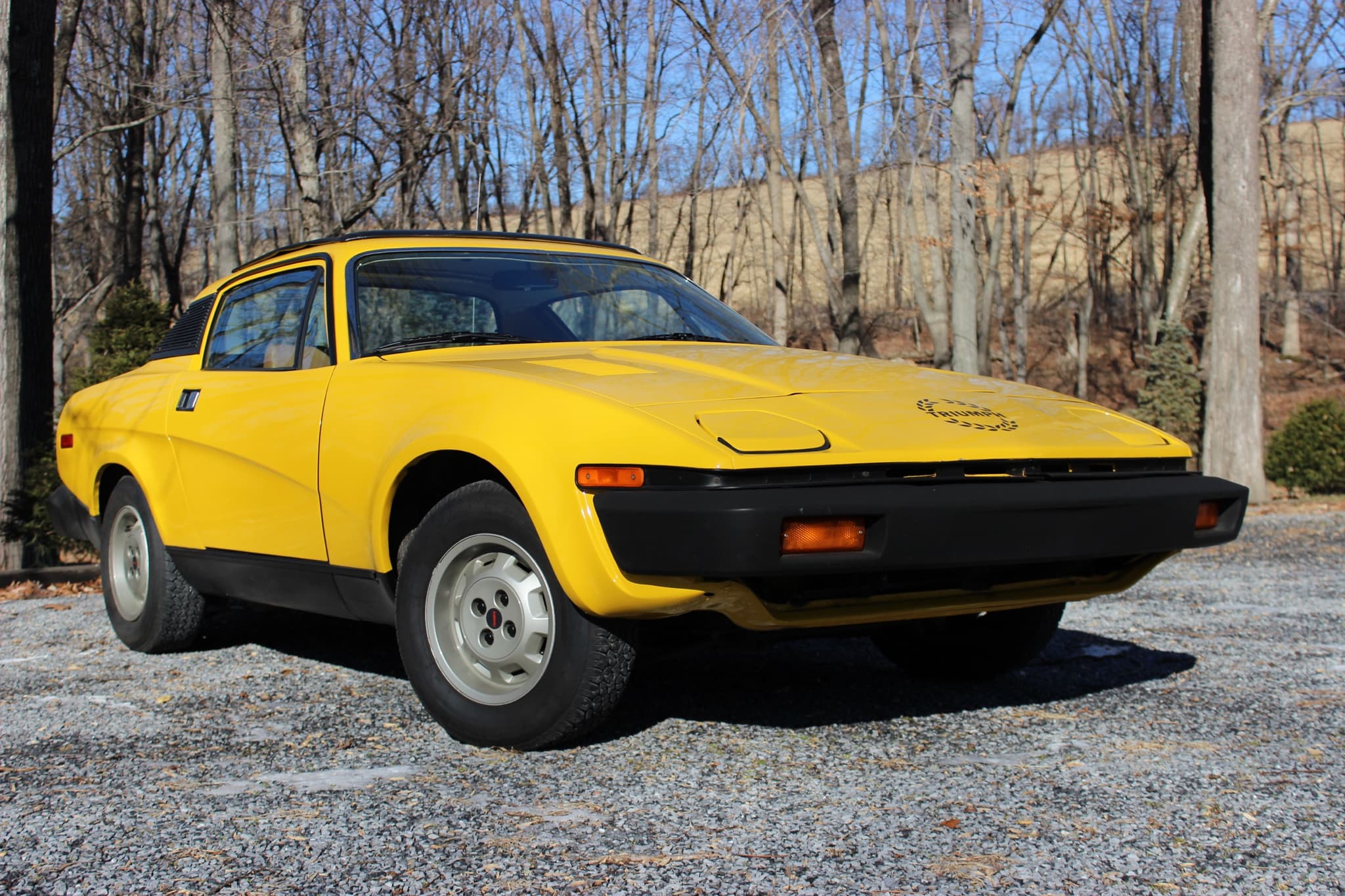
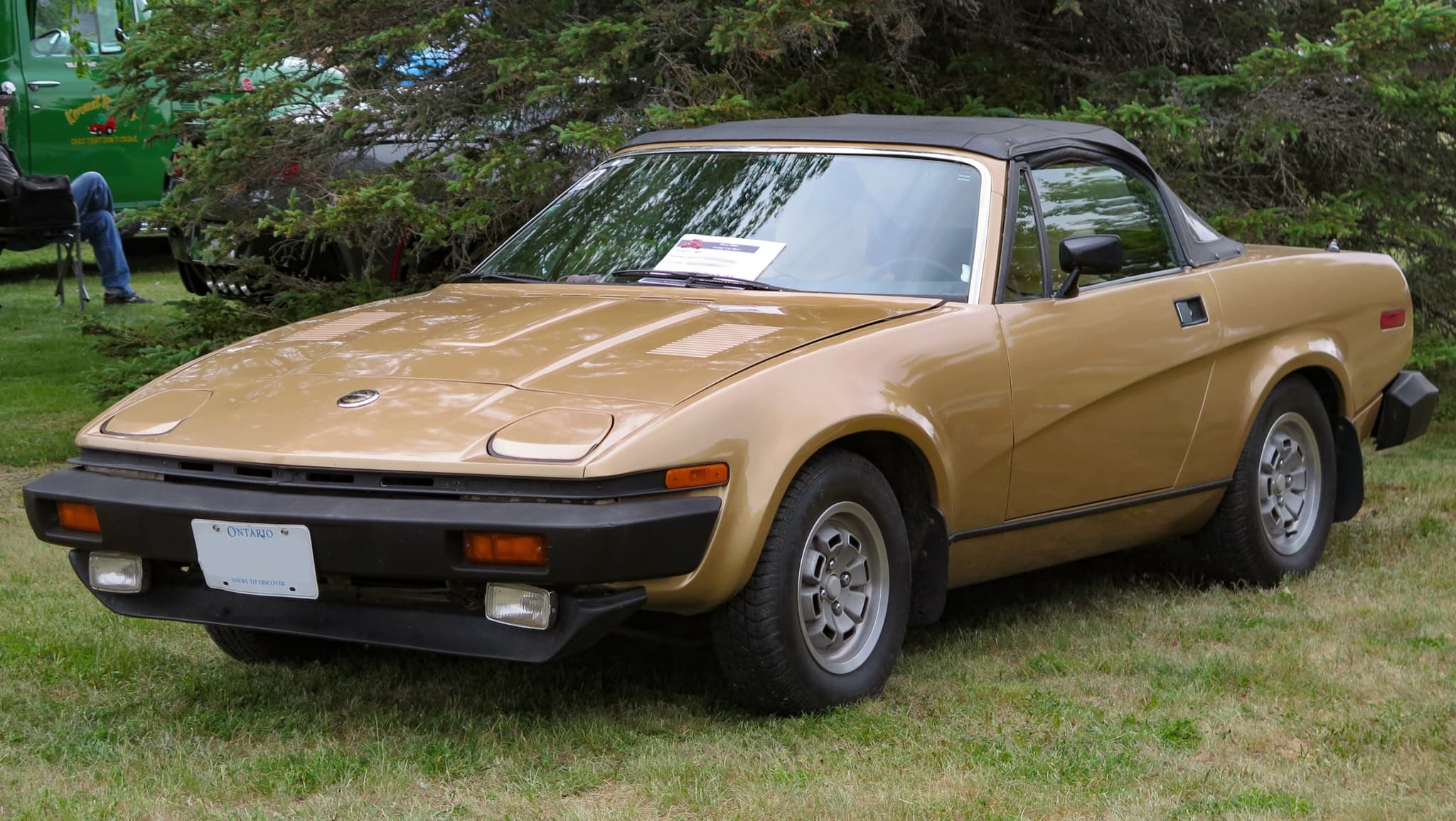
A North American TR7 coupé of 1979–80, with the laurel-wreath decal on its nose, long moulded bumpers and side markers, on gravel before winter woods in Pennsylvania in 2015.Jacob Frey 4A, CC BY 2.0
The TR7 was an American car first. British Leyland launched it to the American press at the end of January 1975, and it reached showrooms there, in limited numbers, that April; British buyers waited until May 1976. Its stylist said as much, looking back:
It was really only planned for America. There was no reason to think it would be a European car.
The American owners' newsletter dated the first sales to April 1975, and so does Mike Cook, later the importer's public relations manager in America, though Ate Up With Motor, which also gives April, draws on Cook's book. American cars are described here by model year, which began with the first cars in January 1975 and afterwards, for BL, in June to October of the calendar year before: the 1976 model year started in September 1975.source 1source 2source 3source 4source 5source 6
Model year by model year
US production began at Speke in January 1975. Each model year's cars can be told by their commission numbers, and from October 1979 by their VINs:
| Model year | Built | Numbers | What was new |
|---|---|---|---|
| 1975 | January to September 1975, Speke | ACL 1 to ACL 7248 | The coupé, with a four-speed gearbox (transmission) and no overdrive; air conditioning optional |
| 1976 | September 1975 to October 1976, Speke | ACL 10001 to ACL 34099, or 33775 | Five-speed and automatic gearboxes optional, but no automatic in California; Southern Skies and the Victory Edition in mid-1976 |
| 1977 | September 1976 to May 1977, Speke | ACW 1 to ACW 17115 | Tartan seat inserts from the spring of 1977, and a lower ride |
| 1978 | June 1977 to May 1978, Speke | ACW 30001 to 33051 and 40001 to 44328 | Few built, because of the strike |
| 1979 | October 1978 to October 1979, Canley | TCW 100001 to 115604 (coupé); TCT 100001 to 105825 (convertible) | The Canley changes; the convertible, on sale from July 1979 |
| 1980 | June 1979 to September 1980, Canley and Solihull | TCT 110001 to 115897, then VINs; Solihull's from 400001 | Fuel injection in California from 1 July 1980; the Spider |
| 1981 | September 1980 to October 1981, Solihull | VINs from 402027, then from 406001 with the SAT prefix | Fuel injection on every car |
The five-speed gearbox was standard in every market during 1978, Ate Up With Motor writes; whether the last Speke cars, of the 1978 model year, had it as standard, no source read shows. The VINs of October 1979 had 14 characters, and North American cars built from May 1981 carried the full 17, with the SAT prefix and a check digit, by the TR Drivers Club's guide. Cars listed as "1982 TR7s" are late-sold cars, as the year-by-year page explains.source 6source 2source 1source 7source 8
What changed for America
The engine was the same slant-four, detuned for the federal emissions rules: lower compression, two Zenith-Stromberg 175CD carburettors in place of Britain's SUs, and Lucas transistorised ignition. Cars for California, with its stricter rules, had a single carburettor and less power still. AROnline reads the two tunes as proof that BL "had no suitable 'federal' engine". Motor Sport, previewing the car in 1975, was blunter: no power output was quoted for the American engine, it wrote, "probably because we would all laugh at the figures".
By 1980 the 49-state engine had lost a little more power, by Ate Up With Motor's account. Then fuel injection came, Bosch's L-Jetronic, first to California's cars from 1 July 1980 and, for the 1981 model year, to every American car. The ratings for each are in the specifications, with their sources: the American launch figure is an SAE net rating and the British car's a DIN one, and the two cannot be set directly against each other. When the British car arrived, the magazine compared them anyway:
At least our UK model has more hairs— well, fluff—on its chest than the emission-strangled US version: 15 b.h.p. extra, to be exact, lifting output to 105 b.h.p. …
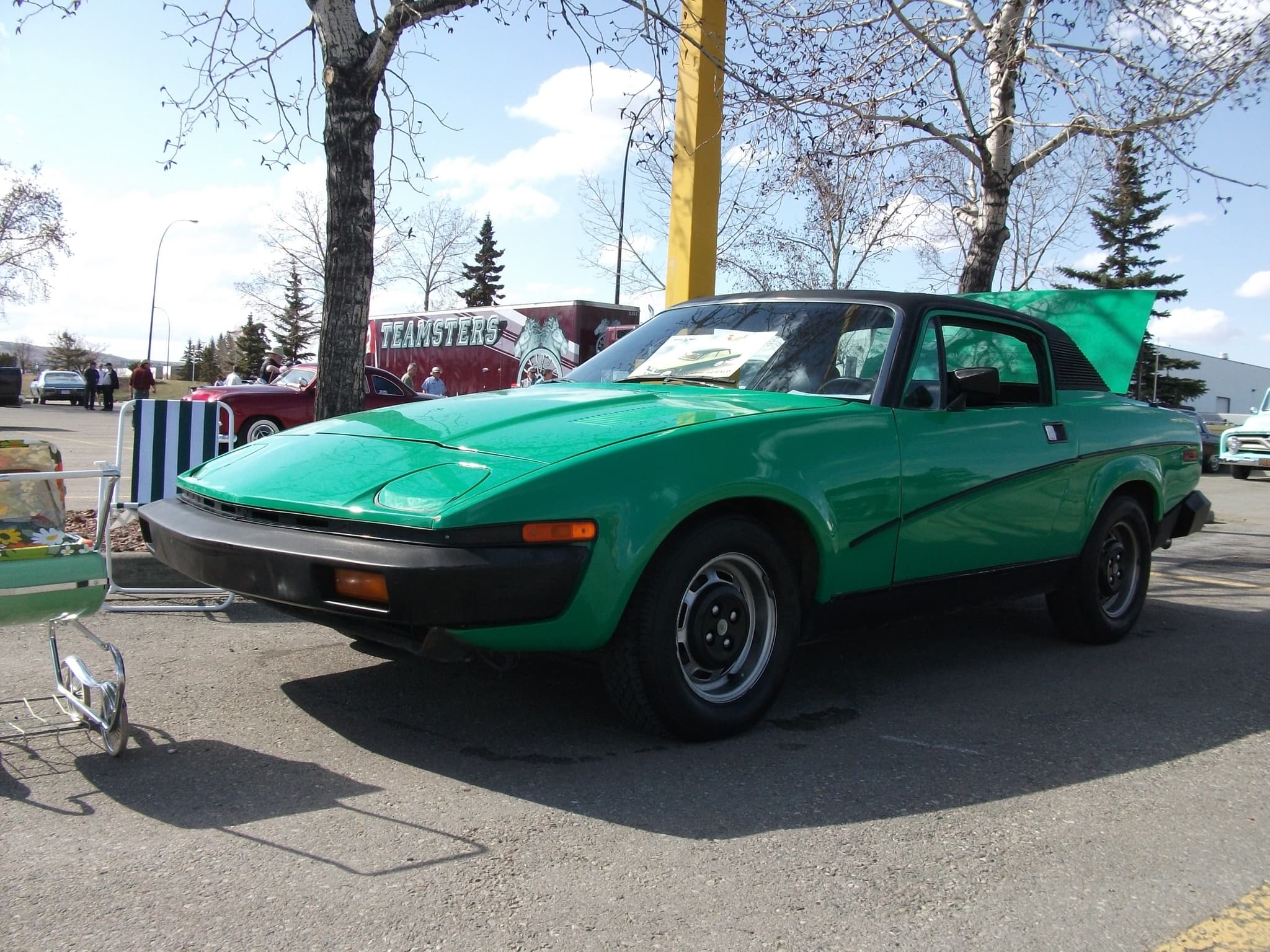
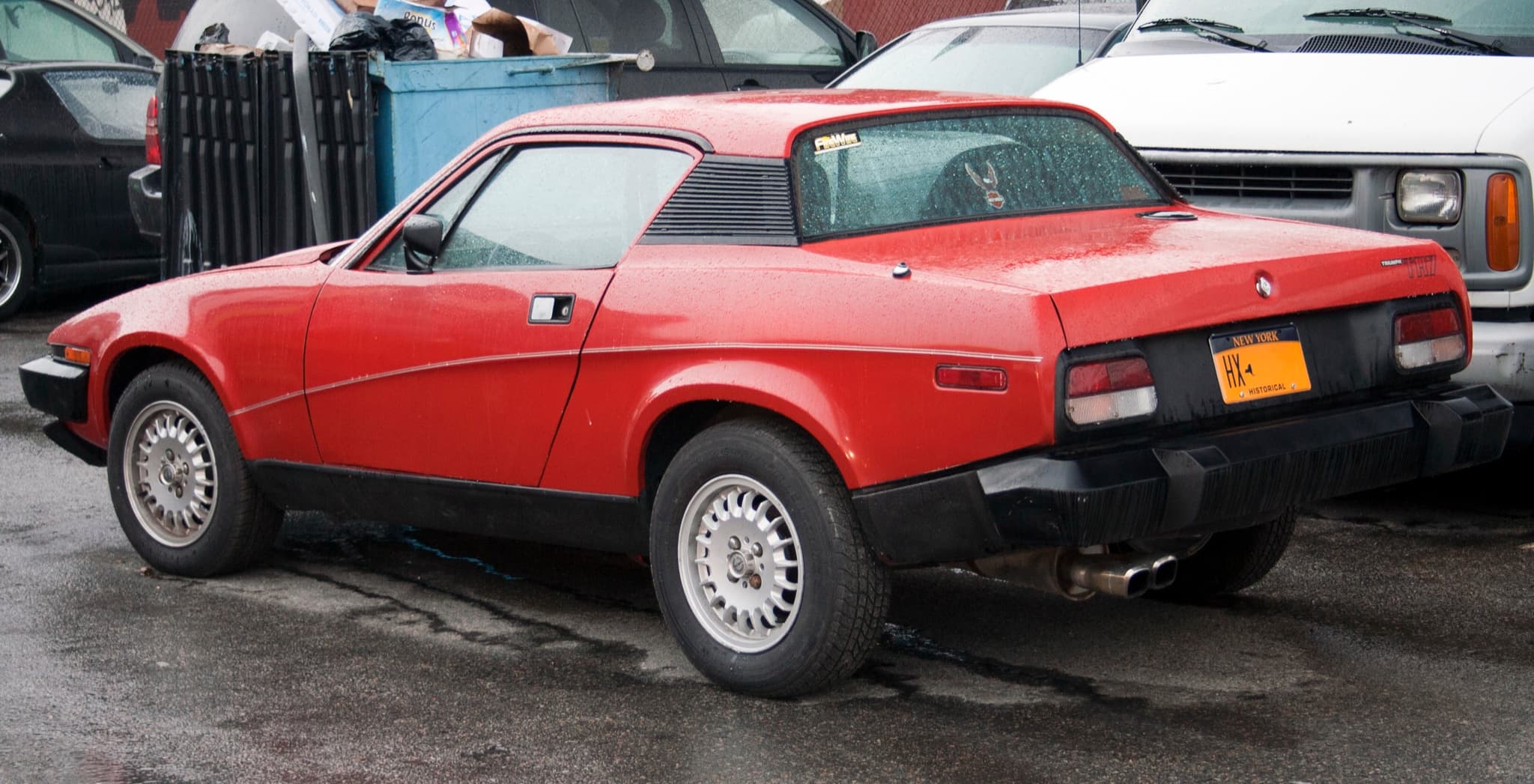
The body changed too. Bumpers built to take an 8 km/h (5 mph) impact, of box-section steel under a skin of self-skinning foam, with moulded overriders (bumper guards), made the American car 140 mm (5.5 in) longer than the British one; side-marker lamps went on the wings (fenders), most American cars had a front spoiler, and the steering wheel had a large padded centre. Under the skin were a front end designed to crumple, side-intrusion beams in the doors and the fixed roof.
Some American TR7s never crossed the Atlantic new. James TenCate's account of the production numbers, reprinted by the TR Drivers Club, notes cars bought in Britain by American servicemen and shipped home as personal exports.source 1source 2source 9source 10source 11source 12source 13source 6source 14
Selling it in America
The TR7 was priced over $700 above an MGB tourer and about $200 below the TR6, Ate Up With Motor writes, and dealers sold it beside the TR6. The importer's newsletter counted more than 9,000 in the first year, and AROnline's figures give 6,211 TR7s sold in 1975, about 16,000 in 1976 and 18,000 in 1977; about 65,000 were sold in America in all. By 1980 a TR7 cost about $10,000.
The early cars brought trouble with them: warranty costs averaged more than $500 a car, Ralph Nader's Center for Auto Safety complained to the federal safety agency in 1977, and owners filed a class action for $15.5 million in July 1978. Michael Lamm, recalling the period in 1999, wrote that the American company cut its dealers from about 1,200 to 400, and that Triumph's American sales fell from nearly 30,000 in 1977 to 12,733 in 1979, every model counted. By the 1981 model year buyers were being offered rebates.
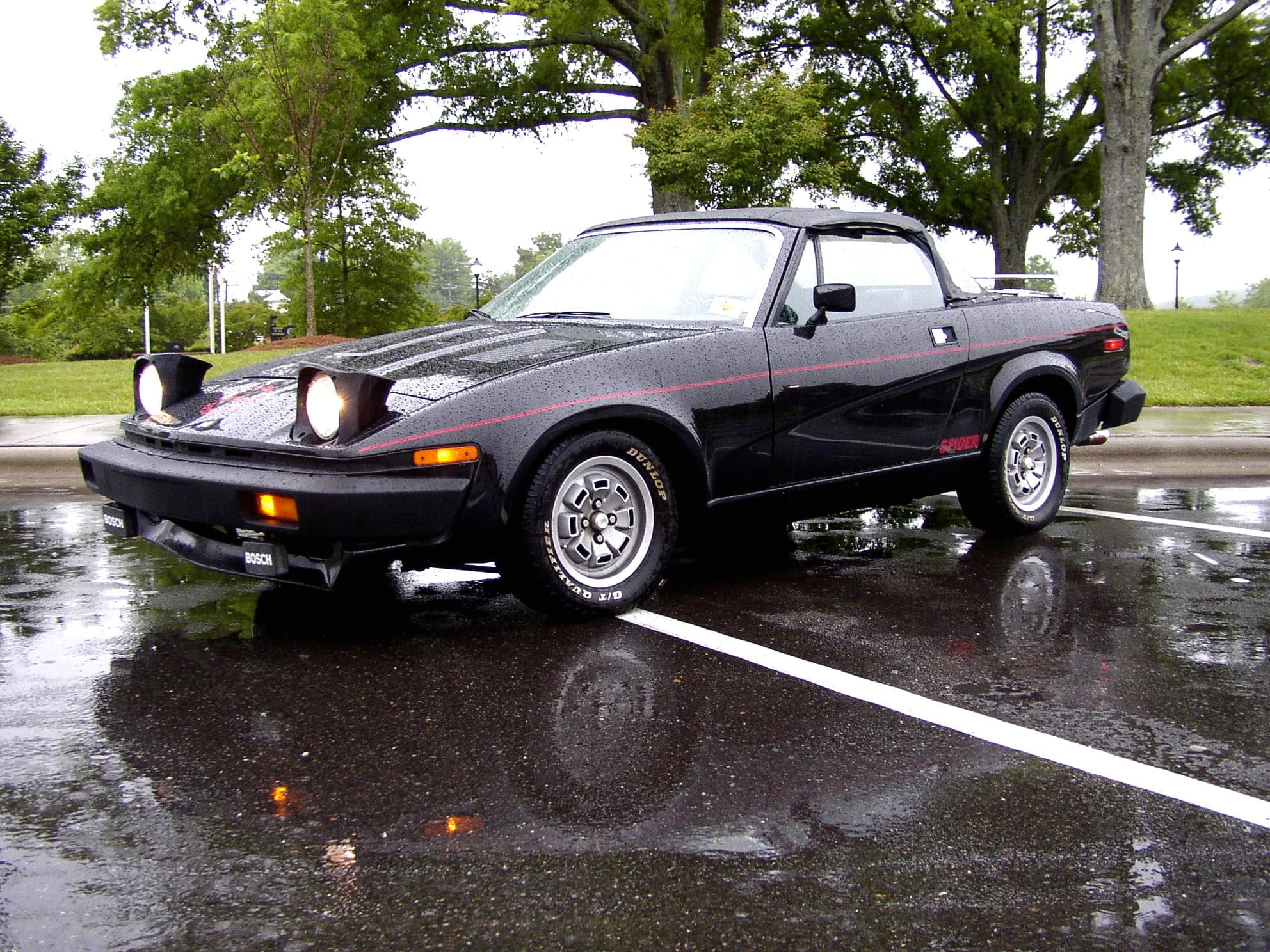
Special editions were an American habit: a regional Southern Skies package and a Victory Edition in mid-1976 that, Ate Up With Motor writes, celebrated its racing, and the Spider, a convertible edition, for the 1980 model year. Dealers disliked them, Ate Up With Motor adds, citing Cook, because they offered extra equipment at a discount and cut the dealers' margins. Special editions gives what is known of each.source 2source 3source 15source 16source 8
Canada and Australia
Canada had the federal car, with its own code in the VIN, L, and the suffix M on its commission numbers. It also had its own striping and wheels, and its own name for the car: AROnline writes that it was sold as "the magnificent seven". Canada's brochure for the convertible printed engine figures of its own; the specifications list them. In 1982 Canadian dealers were still advertising new TR7s as that year's cars.
Australia took the home-market cars, which the factory's records group as "Home Market, Europe and Australia", with K in the VIN. According to Wikipedia, citing the Australian guide What Car Is That? of 1981, they had a federal-type engine to meet Australia's emissions rules. A code for Japan appears in the club's list too, with a note that it may never have been used.source 6source 17source 12source 18
Competition
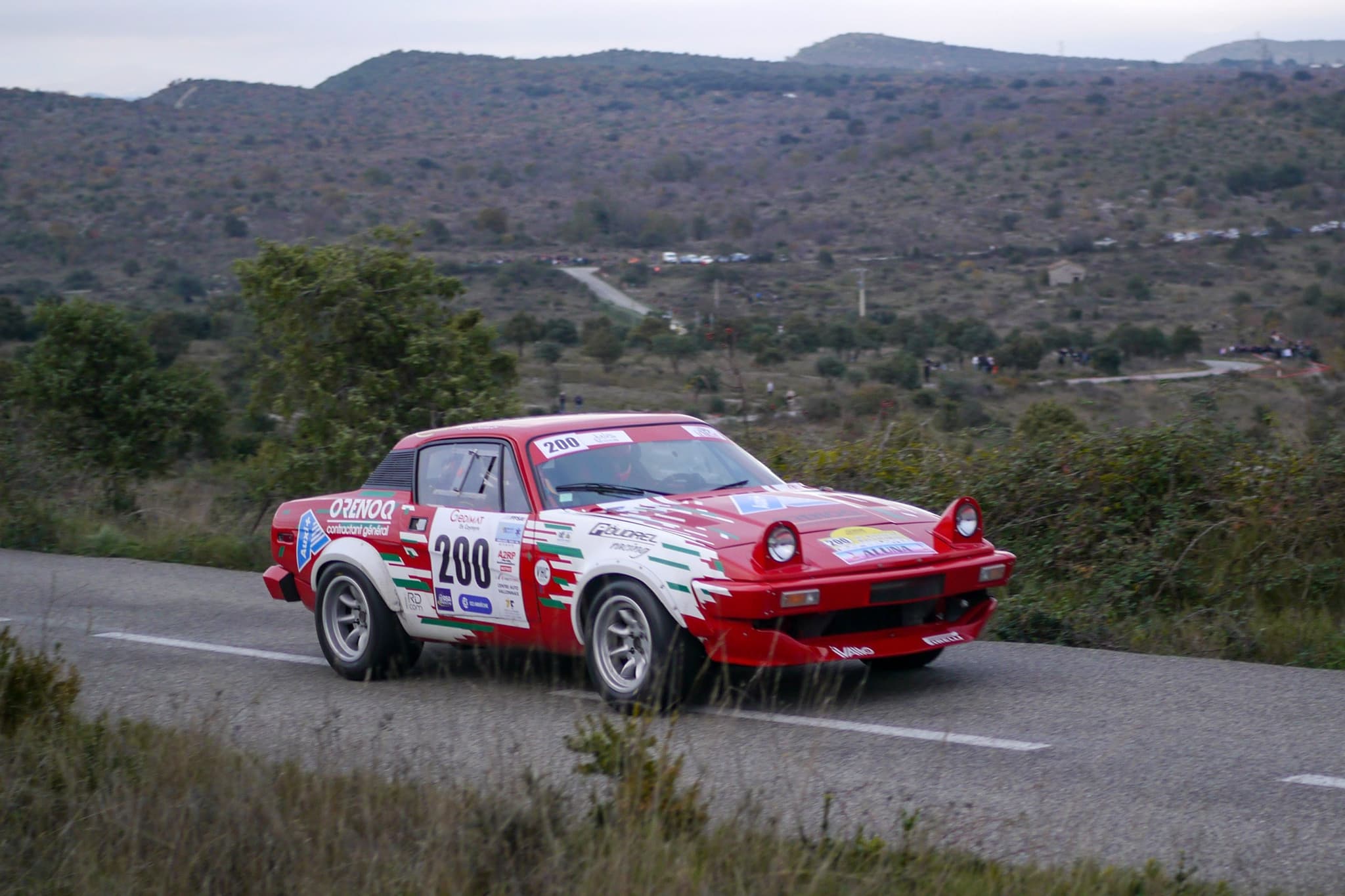
In North America the TR7 was a winner. In rallying, John Buffum won the Sports Car Club of America's Pro Rally championship in TR7s and TR7 V8s four years running, from 1977 to 1980; Ate Up With Motor, citing the Triumph Newsletter, records that seven of BL's eight North American rally wins in 1977 were his. On the circuits Group 44 raced TR7s in the SCCA's D Production class in 1976, winning at Lime Rock that April, and Ate Up With Motor records Lee Mueller's national title in a TR7 in 1979. Racing and rallying tell both in full.source 2source 19source 20source 21
Sources
Every source the site cites is on the sources page.
- Primarymade at the time, by the maker or by people who were there
- Referenceserious later work: clubs, specialists, magazines, books
- Uncheckedencyclopaedias and enthusiast sites: cited beside a good source, named in the sentence, or marked Unchecked
- Clive Richardson ("C.R."), "The TR7 makes a quiet British bow", Motor Sport, Feb 1975, p. 30, p. 30, the American press launch at the end of January 1975; p. 30, four-speed; air conditioning; the padded wheel; p. 30, 8-to-1, the Zenith-Stromberg 175CDs, Lucas transistorised ignition, the 5 mph bumpers, the crumple zone, air conditioning; "No power-output is quoted …". motorsportmagazine.com/archive/article/february-1975/30/the-tr7-makesa-quiet-british-bow Primary
- Aaron Severson, "Way of the Wedge: The Triumph TR7 and TR8", Ate Up With Motor, 5 Feb 2012, pp. 1–5, p. 3, on sale in April 1975; p. 2, the lower ride height and fuel injection; p. 3, the 1976 options, no automatic in California, tartan in spring 1977, the editions, five-speed standard in 1978; p. 2, the federal and California engines; the length; the captions: side markers and front spoiler; p. 3, the price against the MGB and TR6; the warranty costs; Nader; the class action; Southern Skies and the Victory Edition; p. 4, the dealers and the editions; about $10,000 by 1980; rebates; p. 3, Group 44's 1976 season; Mueller's title, 1979; Buffum's seven wins in eight, 1977, citing the Triumph Newsletter. ateupwithmotor.com/model-histories/triumph-tr7-tr8 Reference
- Triumph Sports Owners Association, Triumph Sports Owners Association Newsletter, May–June 1976, May–Jun 1976, "in limited quantities in April of last year"; "over 9,000" in the first year. vintagetriumphregister.org/tsoa/TSOAMayJun76.pdf Primary
- Michael L. Cook, "1981 Triumph TR8: Fast and Last", Special Interest Autos, no. 156, Nov–Dec 1996, pp. 10–17, the North American launch, April 1975. triumphtr8.com/tr8-press-articles-and-cuttings Reference
- Richard Gunn, "Obituary: Harris Mann 1938–2023", AROnline, 15 Aug 2023, the 2005 interview: "It was really only planned for America …". aronline.co.uk/people/harris-mann Reference
- Paul Towle and Rex Holford (update) and Mark Elbers (update), "TR7 & TR8 Identification & Production Data Explained", TR Drivers Club, 1987, updated (© 2016), US production from January 1975; the model years by prefix; ACL, ACW, TCW and TCT ranges and dates; the VINs from October 1979; SAT and the check digit, 1981; the 1976 model year from September 1975; VIN codes L and K; suffix M; ACG, "Home Market, Europe and Australia"; J. trdrivers.com/tr7_-_tr8_vin_numbers.htm Reference
- Thos L. Bryant, "New from Britain: Triumph TR7 Convertible & TR8", Road & Track (reprinted by the TR Drivers Club), 1979, the convertible on sale in the US from July 1979. trdrivers.com/articles21/newfrombritain1.html Primary
- Michael Hart, "Counting TR7 Spiders: A Day at the Gaydon Archive", Triumph Wedge Owners Association, © 2013, California injection from 1 July 1980; the Spiders, 400301–401918; every 1981 car injected; the Spider. triumphwedgeowners.org/spider Reference
- Keith Adams, "The Cars: Triumph TR7/TR8 development story", AROnline, updated 8 Feb 2024, "had no suitable 'federal' engine"; the bumpers; the padded wheel. aronline.co.uk/cars/triumph/tr7-tr8/bullet-development-story Reference
- Clive Richardson ("C.R."), "Triumph TR7: sports car or two-seater saloon?", Motor Sport, Jun 1976, p. 63, p. 63, "At least our UK model …". motorsportmagazine.com/archive/article/june-1976/63/triumpuh-tr7 Primary
- Rover Triumph (reprinted by the TR Drivers Club), "Triumph TR7 Drophead: Structural Engineering and Specifications" (press release), Press release, for release 2 Mar 1980, the side-intrusion beams. trdrivers.com/articles21/tr7dhcengspec1.html Primary
- Jaguar Rover Triumph Canada (Burlington, Ontario), Triumph TR7 Convertible (sales brochure), Canada, c. 1979–80, the length in inches; the Canadian engine. archive.org/details/triumph-tr7-convertible-car-brochure Primary
- Lancaster Insurance, "The Triumph TR8 remembered", 12 May 2022, the fuel systems reversed. lancasterinsurance.co.uk/news/2022/may/12/the-triumph-tr8-remembered Unchecked
- James TenCate, "Production Numbers – A Detective Story", TR Driver (TR Drivers Club), 2012 no. 2, personal-export cars. trdrivers.com/articles21/prodnumbers1.html Reference
- Chris Cowin, "History: Exporting British cars to the USA – Part Two", AROnline, 31 May 2025, updated 21 Oct 2025, 6,211 in 1975, about 16,000 in 1976, 18,000 in 1977; about 65,000 in all. aronline.co.uk/history/exporting-british-cars-to-the-usa-part2 Reference
- Michael Lamm, "1st Drive in the Triumph TR8", British Car, Feb–Mar 1999, pp. 46–48, dealers cut from about 1,200 to 400; Triumph's US sales, 1977 and 1979. triumphtr8.com/tr8-press-articles-and-cuttings Reference
- Chris Cowin, "History: Exporting British cars to Canada – Part Two: The British Leyland Years", AROnline, 19 Aug 2025, "the magnificent seven"; striping and wheels; 1982 TR7s. aronline.co.uk/history/exporting-british-cars-to-canada-pt2 Reference
- Wikipedia (EN), "Triumph TR7", 2026, Australia, citing What Car Is That? (1981). en.wikipedia.org/wiki/Triumph_TR7 Unchecked
- Chris Turner (credited by the club), "The Works Triumph TR7 V8 Rally Cars" and the car pages (group), TR Drivers Club, rally history: Buffum's four North American titles. trdrivers.com/articles21/rallyhistory.html Reference
- Triumph Sports Owners Association, Triumph Sports Owners Association Newsletter, March–April 1976, Mar–Apr 1976 (vol. 22 no. 2), Lime Rock, 24 April 1976. vintagetriumphregister.org/tsoa/TSOAMarApr76.pdf Primary
- Triumph Sports Owners Association, Triumph Sports Owners Association Newsletter, November–December 1976, Nov–Dec 1976, the 1976 Runoffs. vintagetriumphregister.org/tsoa/TSOANovDec76.pdf Primary