Triumph TR7 Lynx
The TR7 family British Leyland planned and prototyped: the Lynx 2+2 that died with Speke, a stretched Broadside meant for 1983, an MG-badged stopgap and an O-Series TR7, all cancelled. Two Broadsides and a Lynx survive at Gaydon.
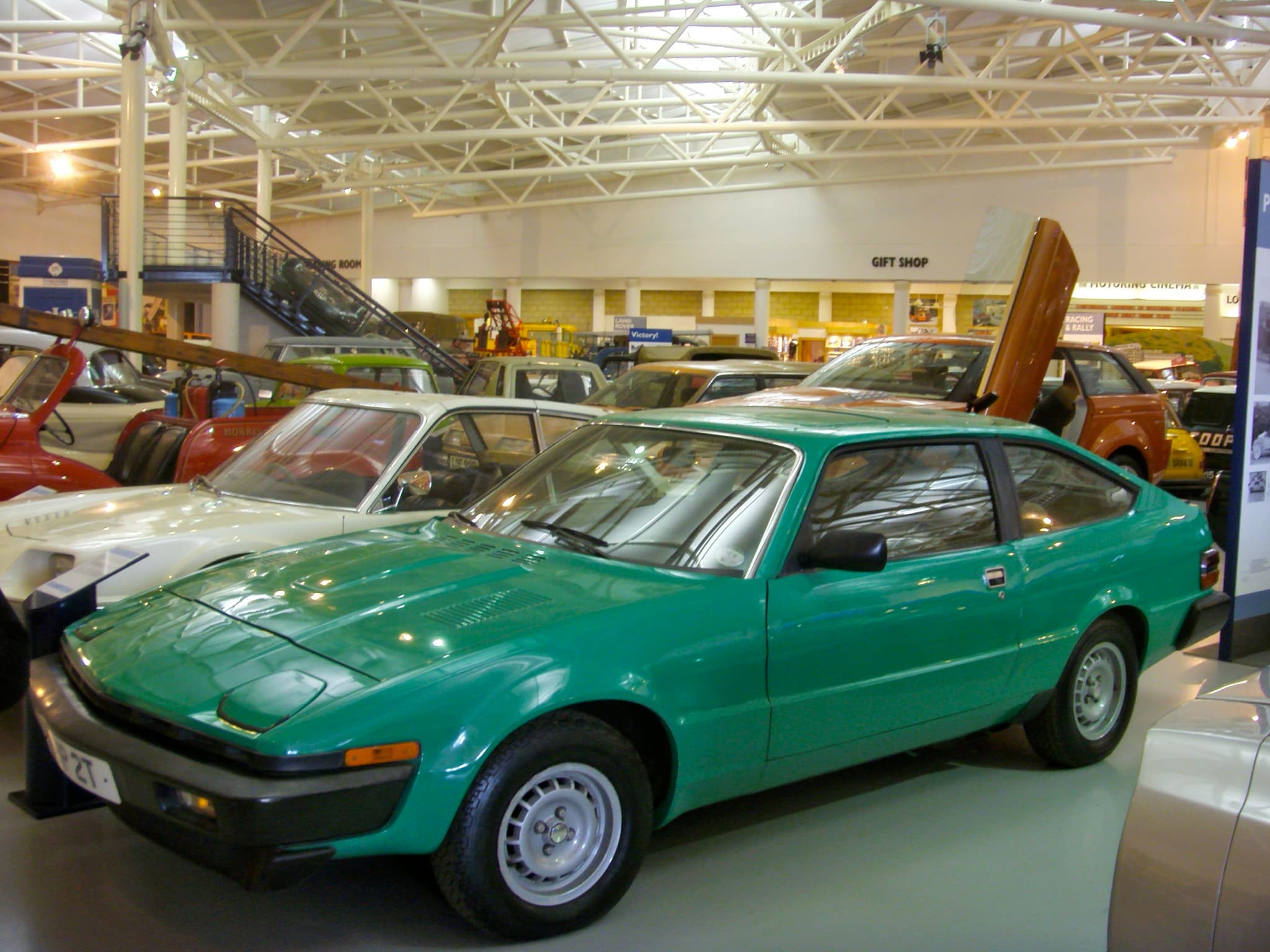
British Leyland meant the TR7 to head a family, and only the convertible and the TR8 went on sale. The rest got as far as prototypes. There were two Lynxes, a Broadside, an MG and a TR7 with a different engine, and all were stopped; the later ones by the closure of a factory, by the American market, or by a company that had to choose what to spend its money on.source 1source 2source 3source 4
The Lynx
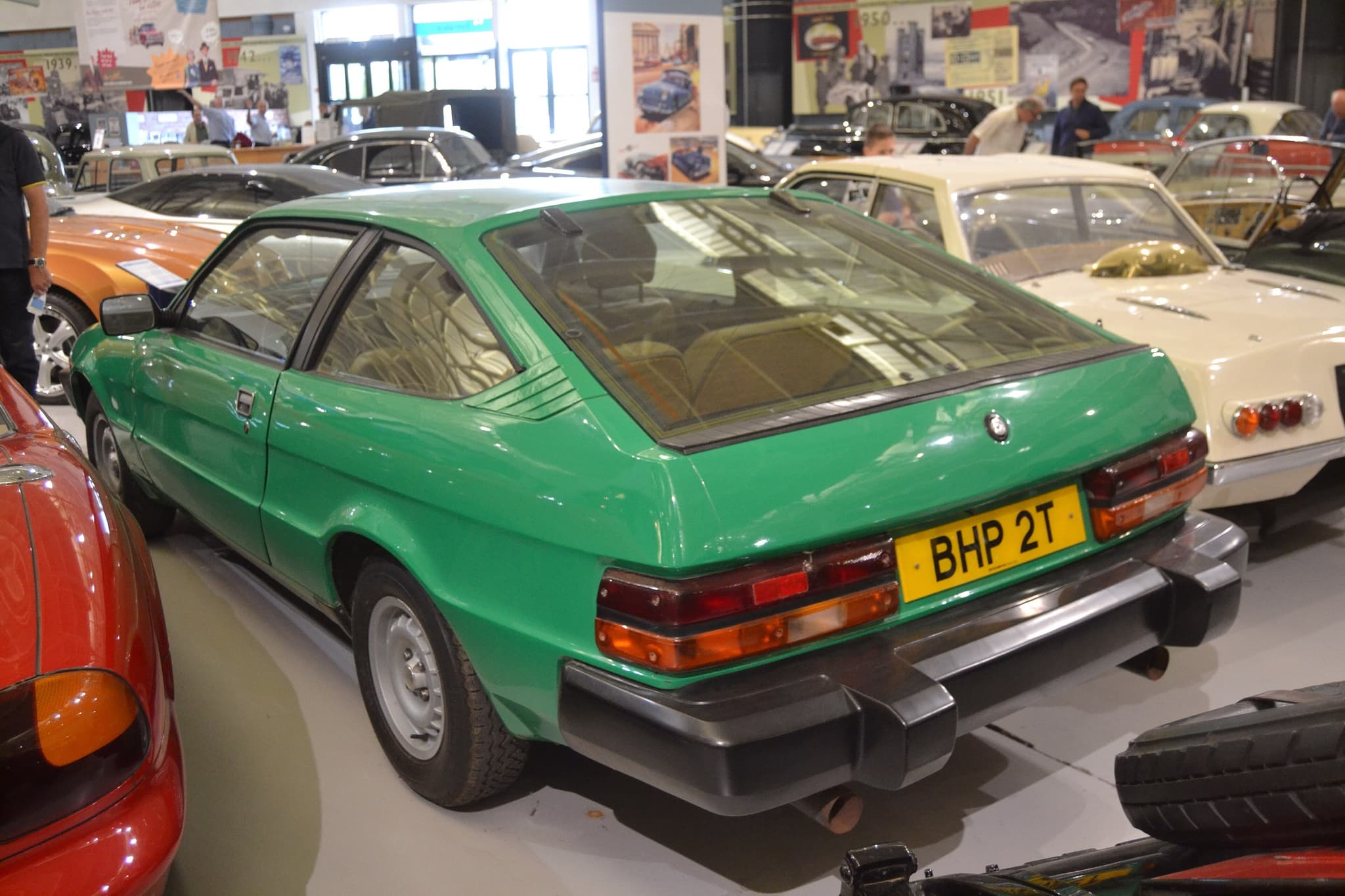
There were two cars of that name. The first, of 1968–69, was a 2+2 fastback with a hatchback, drawn by Triumph's Les Moore with Giovanni Michelotti to succeed the GT6, and Leyland cancelled it in 1969. The second, begun in 1971–72, was a 2+2 hatchback built on the TR7's mechanical parts and first drawn by John Ashford of Triumph's studio; Ate Up With Motor writes that its final form returned largely to his design, with David Bache's influence. It was to replace the Stag and take on Ford's Capri, with Rover's V8 for the Triumph and BL's O-Series four for an MG version, the five-speed gearbox (transmission) of Rover's SD1 and the SD1's rear axle. Its wheelbase was longer than the TR7's, by 305 mm (12 in) in AROnline's account, or by 279 mm (11 in) from Ate Up With Motor's figures, by our arithmetic, and it had longer doors.
BL gave it the go-ahead for Speke, and by 1977 tooling had begun for a launch in 1978. The closure of Speke in 1978 ended it. Why is told three ways. AROnline puts it down to the plant; Ate Up With Motor adds that Bruce McWilliams later told David Knowles he had said again, at the meeting where the Lynx was decided, that it would not sell in America, and that the Speke workers thought BL simply lacked the money; and the museum's notes, as the TR Drivers Club reproduces them, add the falling American market, the exchange rate and its costs. AROnline's own verdict:
The Triumph Lynx was a victim of not only a lack of funds, but also the ongoing battle between Michael Edwardes and the Trade Unions.
The museum's notes say that 15 running prototypes were built and that 75% of the Lynx's sales had been meant for America; Wikipedia gives 18 prototypes. One survives: the left-hand-drive Lynx in Java Green at the British Motor Museum, Gaydon.source 1source 2source 5source 4source 6
The Broadside, the Boxer and the O-Series TR7
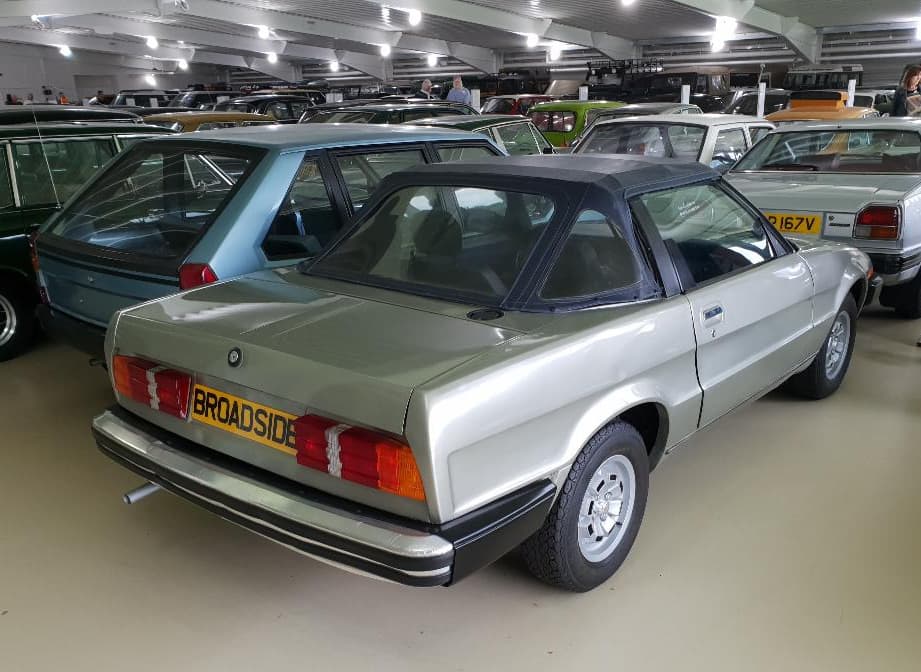
After the Lynx came the Broadside, first called SC1 and then RT061: a coupé and a convertible on the TR7's underbody, stretched by 127 mm (5 in) in AROnline's account, or by about 100 mm (4 in) from Ate Up With Motor's 2,260 mm (89 in) wheelbase, by our arithmetic, and fitted with the Lynx's doors. It was to have the O-Series engine or an injected Rover V8. David Bache's studio styled it, and Michelotti restyled the coupé late in 1979; by BL's plan of 1980 it would be launched in the spring of 1983. Two styling prototypes survive at Gaydon, the museum's notes record: a Broadside GT, a 2+2 hatchback made from a Lynx shell, in Bordeaux red with a British-specification TR8 engine, and a silver drophead with an O-Series engine. AROnline writes that BL dropped the Broadside when it put its money into the Metro and the Maestro, after changes in interest rates made exports to America unprofitable, and when the new Light Medium division of 1980 ended Rover-Triumph's independence; the museum's notes date its end to late 1980.
It would take until the mid-1990s, and the arrival of the MGF, before the TR7 and MGB were replaced – a tragedy in itself.
The MG Boxer, RT078, was to be a TR7 with MG badges, a cheap stopgap to replace the MGB in the spring of 1981; Ate Up With Motor, citing Knowles, writes that its tooling was to cost no more than £1 million. It was cancelled by the middle of 1980, after a marketing study predicted poor sales and warned that it would offend MG's buyers. The O-Series TR7, planned for the autumn of 1981, got further: Canley Classics' records of the experimental fleet list about 25 development cars, most of them listed as scrapped in June 1981, though many survive, often re-engined with V8s. One BL engineer, Tony Cooke, remembered its end, as AROnline quotes him: "I was told O-Series would not pass North American emissions specification, and the project was cancelled. We had just wasted months." According to Canley Classics, a turbocharged O-Series TR7 lapped MIRA at an average of 207.86 km/h (129.16 mph), the fastest ever Triumph.
Smaller plans went the same way: a hardtop for the convertible, RT066, and model-year changes for the TR7 and TR8, RT057, AROnline records. One derivative was finished, though not by BL: Crayford Engineering's Tracer, a sporting estate made in 1976–77 for the dealer Page Motors. It stayed the only one, AROnline writes.source 3source 1source 4source 7source 8source 9source 10
Sources
Every source the site cites is on the sources page.
- Primarymade at the time, by the maker or by people who were there
- Referenceserious later work: clubs, specialists, magazines, books
- Uncheckedencyclopaedias and enthusiast sites: cited beside a good source, named in the sentence, or marked Unchecked
- Aaron Severson, "Way of the Wedge: The Triumph TR7 and TR8", Ate Up With Motor, 5 Feb 2012, pp. 1–5, pp. 1–2, the first and second Lynx; p. 4, the Lynx's end, the Boxer, the O-Series TR7 and the Broadside; p. 1, the Les Moore and Michelotti Lynx, cancelled in 1969; p. 2, the second Lynx, its wheelbase, its engines, the Stag and the Capri; p. 4, Ashford and Bache, the tooling, McWilliams to Knowles, the Speke workers' view; p. 4, the Broadside's wheelbase and launch date; the Boxer and its tooling; the O-Series TR7. ateupwithmotor.com/model-histories/triumph-tr7-tr8 Reference
- Keith Adams, "Concepts and Prototypes: Triumph Lynx (1972–1978)", AROnline, 20 Jan 2024, the two Lynxes; the end; "extended by 12 inches"; Speke; the tooling; the closure; "The Triumph Lynx was a victim …". aronline.co.uk/cars/triumph/tr7-tr8/triumph-lynx Reference
- Keith Adams, "Concepts and Prototypes: Triumph Broadside (1979–1981)", AROnline, 2 Feb 2024, RT061; SC1 and RT061; "stretched by five inches"; the Lynx's doors; the engines; Bache and Michelotti; the LC8 and LM10; interest rates; the Light Medium division; Tony Cooke; "It would take until the mid-1990s …". aronline.co.uk/cars/triumph/tr7-tr8/triumph-broadside Reference
- Keith Cox, "Gaydon cars with a TR7 connection", TR Drivers Club, the Lynx and the two Broadsides at Gaydon; Lynx: 15 running prototypes, 75% for the US, the reasons, the survivor, Java Green; Broadside: the GT and the 2+2, the Bordeaux red GT with a TR8 engine, the silver drophead with an O-Series; late 1980. trdrivers.com/articles21/gaydoncars.html Reference
- Keith Adams, "The Cars: Triumph TR7/TR8 development story", AROnline, updated 8 Feb 2024, the Lynx died with Speke. aronline.co.uk/cars/triumph/tr7-tr8/bullet-development-story Reference
- Wikipedia (EN), "Triumph TR7", 2026, 18 prototypes. en.wikipedia.org/wiki/Triumph_TR7 Unchecked
- Canley Classics, "TR7 & TR8 Experimental Records", the O-Series development fleet. canleyclassics.com/api/archive/article/?q=tr7-tr8-experimental-records Primary
- Canley Classics, "The Fastest Ever Triumph", the turbocharged O-Series car at MIRA. canleyclassics.com/api/archive/article/?q=the-fastest-ever-triumph Reference
- Keith Adams, "History: Secret Rover and Triumph model plans (1978–1987)", AROnline, 15 May 2024, RT057, RT058, RT061 and RT066. aronline.co.uk/history/rover-triumph-secret-model-plans Reference
- Declan Berridge, "The converters: Crayford Engineering TR7 Tracer", AROnline, 27 Mar 2023, the Tracer for Page Motors. aronline.co.uk/the-converters/crayford/tr7-tracer Reference